Monday, 2 May 2011

The Southampton ICT conference - worth a weekend?

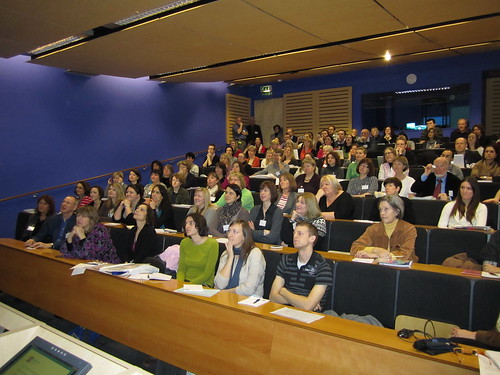
February 2011 Southampton - Linksintolanguages MFL ICT conference - Well, absolutely. For many reasons.


1. Although it was a weekend conference and took away from my home time, as the indefatigable Isabelle Jones says, it was "professional ME time".
2. I met loads of other MFL Twitterers who are a terrific bunch.There is a new phenomenon around when meeting people. First you introduce yourself and then you give your Twitter name and suddenly an extra lightbulb flashes on - "Ohhhh! You're so and so!!!" - it really does add an extra dimension to friendships.
3. Fabulous plenaries, excellent seminars, very good speakers, generous exhibitors and great surroundings. Oh and good food.
4. Plenty of DIFFERENTIATED CPD for all. All seminars were graded for IT skills required - very good to see and I wish more CPD providers would do this.
5. It was serious, thought-provoking, challenging and also fun.
6. Highly motivated teachers are great to learn from and encourage the rest of us not to be shy.

All seminars and Plenary keynote sessions are covered here on Joe Dale's site. Have a look and follow up some leads - they are tremendous and I will certainly try to go again next year and a big thank you to all who organised such a good event.

Monday, 24 January 2011

MYLO for Merlin John

Here is the link to my article for Merlin John mid January. I was delighted to be able to talk about MYLO for his super website

- we are using MYLO with all of our KS3 classes as best we can and giving it a real go. I like it a lot - it's modern, trendy, the pupils can get going on it fairly intuitively apart from a couple of spots where teacher knowledge really helps
1. TELL them to join the class group you have set up for them - there is no prompt
2. Remind them to scroll down to see stuff! It is amazing how often they don't look!

They LOVE the competition and we are trying to catch up with Norton Hill School at the moment - this local Language College is storming ahead. The Ballard School too is one where I know the teacher and it makes a difference if I say we have to beat so and so! Our pupils are learning well with it - they like the style, the avatars and they visit lots of the challenges at one sitting. The next step is to get them producing the final projects - we have set the work to do at home for a number of classes,who seem to be delighted to have an IT homework to do for languages.

If you haven't yet experimented with MYLO I would highly recommend visiting the site and having a go. It's free, well designed and ready to run for classes in KS3 and some KS4. Here's the official plug!

MYLO
Free online language learning website (internet connection required) aimed at pupils studying modern foreign languages at key stages three and four. It contains interactive challenges and support material in French, Spanish, German and Mandarin.
MYLO, has been developed by Lightbox Education, in partnership with the Department for Education, Cambridge University, CILT, ALL and the University of Salford.
MYLO website http://mylo.dcsf.gov.uk
Email contact info@hellomylo.com
Technical support line: 08453 077 834

Monday, 10 January 2011

London Language Show Oct 2010

I had a great time at London Language Show - first time I've made it and it was great to meet many of the teachers I have got to know virtually. Marie France and I ran the gauntlet of the exhibitors' stands looking for good ideas,inspiration, freebies - of which there were fewer - and excellent seminars.


Just a shame about the sound deficiencies - how can they think that running seminars in open-topped tents inside a main exhibition hall is a good idea? Speakers really struggled but all had come prepared. Joe Dale, Russell Stannard and Rachel Hawkes had all learned the hard way last year and had talks already on their blogs or websites - Russell had even recorded a version of his in advance!!

Here are the links to the various sites for these seminars. Joe as ever is full of excellent ideas for using Web 2 technologies in class and he piles on the information so that no-one feels short-changed. If you don't know Joe's website - visit it quick joedale.typepad Joe has a handle on all things ICT for MFL

Rachel Hawkes has so much energy that her seminars are packed full of expectant teachers who know that she'll give fantastic value for money - she didn't disappoint. I really enjoyed both of her seminars and have shared both in school as best I could. Links here for her tremendous material - all at her new website www.rachelhawkes.com

Here's the link for another presentation that Rachel did on ideas to take to the classroom tomorrow - it's full of great ideas that this generous lady is happy to share. I have been promoting it with my department since the London Show.
I'll do a separate post on Russell later - so much to relate!

Sunday, 24 October 2010

HoD Conference Somerset 2010

It was a treat to hear two excellent speakers in Steven Fawkes and Greg Horton at our annual get-together in Bridgewater.

Creativity is a great theme for Steven and he is an amusing and warm-hearted speaker. I felt he said we can do more with less - use little ideas to inspire kids to talk - use lots of mimicry, read numbers like football results, use gesture to reinforce meaning, get kids to talk through pictures and make up stories with simple 10 second sketches as prompts. Much fun was had with colleagues trying out Steven's ideas together. I was only sorry that the wifi was not good at this new centre and Steven was not able to use the One Semester of Spanish Love song which he wanted to show. I will post more ideas when my copy of ppts comes through!

I had heard Greg Horton's name mentioned frequently of late and was therefore looking forward to seeing this innovative winner of the European Language Award.

Group Talk is the title given to the package of ideas which Greg and the team at Wildern School Southampton have used to promote spontaneous talking in their classes.He was keen for us to realise that it doesn't cost more or give you more to do!!What a relief!

Greg outlined the reasons he had started to try to get more speaking to happen in his classes
- Gender gap
- Low numbers opting
- need to get more speaking done by kids
- Transactional tasks are be too boring and rigid.

Greg has been promoting chatting and comparing i.e. authentic discussion about things that interest the pupils. He was keen for us to consider teaching much more language of "conjecture"

Here is what Greg says it involves
• Only target language
• Interaction between a small group of pupils
• Opinion, conjecture and debate
• Language is colloquial du bist die Extrawurst – you’re the odd one out!!
• Fett – it’s cool,sick, wicked!
• Hear, process, respond
• Encourage kids to be themselves

Teach them the language they need for the above
"perhaps, I think, about, that’s rubbish, you’re joking
Think, suppose, estimate, consider, wonder
in short, give them the tools to be able to say what they want to about topics that interest them. It makes perfect sense and Somerset HoDs were inspired.

The Stages of GROUP TALK

1. Exchanging and responding to simple opinions
2. Taking part in a short discussion
3. Exchanging reasons and preferences – talking across time frames
4. Developing a line of thought, balancing an argument, sharing points of view.

Greg's team have had tremendous success with the Project - massive increase in oral exam marks - and we have started to work out how to implement the Group Talk ideas at our school. I would recommend the teachers tv clip about Greg's work at Wildern School as a really good starting point.
Wednesday, 29 September 2010

CPD in Critical Times

I have been very busy thinking hard about how to put together my first presentation for our Head of MFL conference here in rural SW England. It's sort of - flattered to be asked, scared to be doing it!! I've warmed to my theme and here is my presentation - I really have learned so much over the last two years about ways of keeping up with latest technology and using Web2 tools for teaching. I am also a very convinced Twitter user and love Google reader.
I have given useful links on last page of presentation and hope that any one from our conference who finds their way here, will find the ppt useful, practical and not too geeky. Many thanks to Twitter friends and FM friends for assistance and my 2 delightful sons, who are a constant source of patient advice for me and a fount of knowledge.

Thursday, 23 September 2010

Here we go again!

Maybe I will manage better this year - as a Head of Department, I constantly go over what else we can do, should do, could manage to do, to improve learning and teaching - that's my job along with all the other admin bits and pieces which often hold me back from focusing properly on that teaching and learning. Heads of Dept will know exactly what I mean.
Followed a great thread on TES forum about time management and people's ideas about how to manage better. I even took the time to make a list. I am particularly liking the use of an old kitchen timer for 25 minute bursts, with a 5 min gap to do whatever you like in, before resetting the timer if you need to. I can cope with 25 mins but not the thought of 11/2 hours of marking at one go. The system fools me into sensible chunking. So far, so good.

I might manage better this year too as I have some very major things behind me - the OF**** word, - they hit in May - we did well. I did my Leading from the Middle course last year too. It was pretty good, I am quite reflective already, so it maybe wasn't as revealing to me as to some others, but time spent with other Middle Leaders was very enjoyable - glad to see this kind of support is now available (but it may disappear??) Read Alex Blagona's interesting post on his experience of Leadership attempts!

One of our lovely successes last year too was a big joint project with our Partner primary schools. We all did story-telling - can you guess our story?!- and drama and then our year 7s went to visit a Primary school with an MFL teacher - result is that we all performed what work we were each doing, all our team got a chance to go to a Primary school and our Year 7s loved going back to yr 6. What is more, all the teachers are still friends and we understand what we are all doing or trying to do. I call that a result! In the face of so much change at Secondary level, the project with our Primaries was great fun, even if someone reversed the school minibus into a police van on the day of a visit... ooops! No injuries - phew!

So I look forward to a productive but slightly less hectic year and trying to keep my sanity will be a priority!

Thursday, 8 July 2010

Teaching English Grammar to English kids!

The title says it all - we need to teach grammar explicitly, it doesn't just happen; Englishpupils know less grammar than many other European pupils and at Secondary level, we pay a price for having a mother tongue which doesn't have Romance language verb endings. We do have complexities of our own - pronunciation and English phrasal verbs for example - but not verb endings and they still have no real grasp of what a verb is quite often. What can we do?
Well, Charlie Berney - teacher of MFL in Wales, member of ALL West of England committee and frequent, talented speaker in our area - led a good session on her recent attempts to be cross-curricular with a difference. Her main difference is that she goes to the SUBJECT and delivers the content in THEIR lesson and Charlie generously provided us with her CD of materials for an English grammar sequence of lessons, dance, cooking and  Geography.
Most interesting was the fact the her English colleague stayed in Charlie's "What is grammar?" lesson in the English department and was devastated to see the reality that we face often - kids do not appear to know what a verb, noun, adjective, pronoun etc actually are, despite the fact that they have been met in Primary school. Surely this trend is only going to get worse as the Literacy hour disappears again??. Interestingly, when Charlie asked the class to tell her what some grammar terms were going to be in English, they came up with spelling and punctuation rules - "i before e, except after c etc."
Charlie kindly allowed us to use all her grammar booklet and powerpoint from our March conference and I am finding it immensely useful now and plan to use it extensively at the beginning of the academic year. I want to see children who are not afraid of the term "verb", never mind - er verbs and "terminaisons" !